How Many Jobs Should You Apply to Per Day? (The Data Says Less)

You've sent 200 applications. You've heard back from 3. And two of those were automated rejections.
Sound familiar? You're not alone. Across Reddit, thousands of job seekers are sharing the same brutal math.
One mechanical engineering grad on r/jobs applied to over 1,000 jobs in a year. Had 10 different people review his resume. Met every qualification. Zero interviews. His takeaway: "This job search is making me feel worthless."
Another user posted about 600 rejections in 6 months. Twenty-two years of experience. Made a new resume for every single application. Even removed their bachelor's degree when applying to entry-level retail positions. Still nothing.
The advice most people give? "It's a numbers game. Apply to more." But the research tells a completely different story. The data says you should apply to fewer jobs per day, not more. And the difference in results isn't small.
The Mass-Apply Trap: What 1,000 Applications Actually Gets You
Aakash Gupta, a product management writer with a large following, shared on X that he applied to 500 jobs online and got zero interviews. His conclusion? Online applications have roughly a 1% success rate. The thread went viral because everybody recognized the feeling.
The numbers back him up. According to HiringThing's 2025 research, the average corporate job posting receives 250 applications. Out of those 250, only 4 to 6 people get an interview. That's a 2% conversion rate.
Meanwhile, 44% of applicants report being completely ghosted by employers as a routine experience. You don't even get the dignity of a rejection email.
One r/jobs poster put it bluntly: "It is not hard to find a job. It is impossible." They'd been searching for almost a year and couldn't even get hired at McDonald's.
Here's the thing: these people aren't lazy. They're not unqualified. They're playing a game where the rules work against volume.
How Many Jobs Should You Apply to Per Day? The Research
The sweet spot is 2 to 5 quality applications per day, or roughly 10 to 25 per week. That's the range where career experts, recruiting data, and academic research consistently converge.
But the specific number depends on your situation:
- Unemployed and searching full-time: 3 to 5 applications per day (15 to 25 per week)
- Currently employed: 1 to 2 per day (5 to 10 per week)
- Changing careers: 1 to 3 per day (5 to 10 per week). Career transitions require heavier customization per application.
- Senior or executive roles: 1 to 3 per week. At this level, networking and headhunters matter more than volume.
The critical finding comes from Resume Worded's research: job seekers who submit between 21 and 80 total applications have the highest success rate at 30.89%. Once you cross 81 applications, your success rate actually drops to 20.36%.
Read that again. Applying to more jobs made people less likely to get hired.
Why Quality Beats Quantity (By a Landslide)
LinkedIn's data science team found that personalized applications receive 40% more interviews than generic ones. And 63% of hiring managers say they're more likely to hire a candidate who submitted a personalized application specifically tailored to their company.
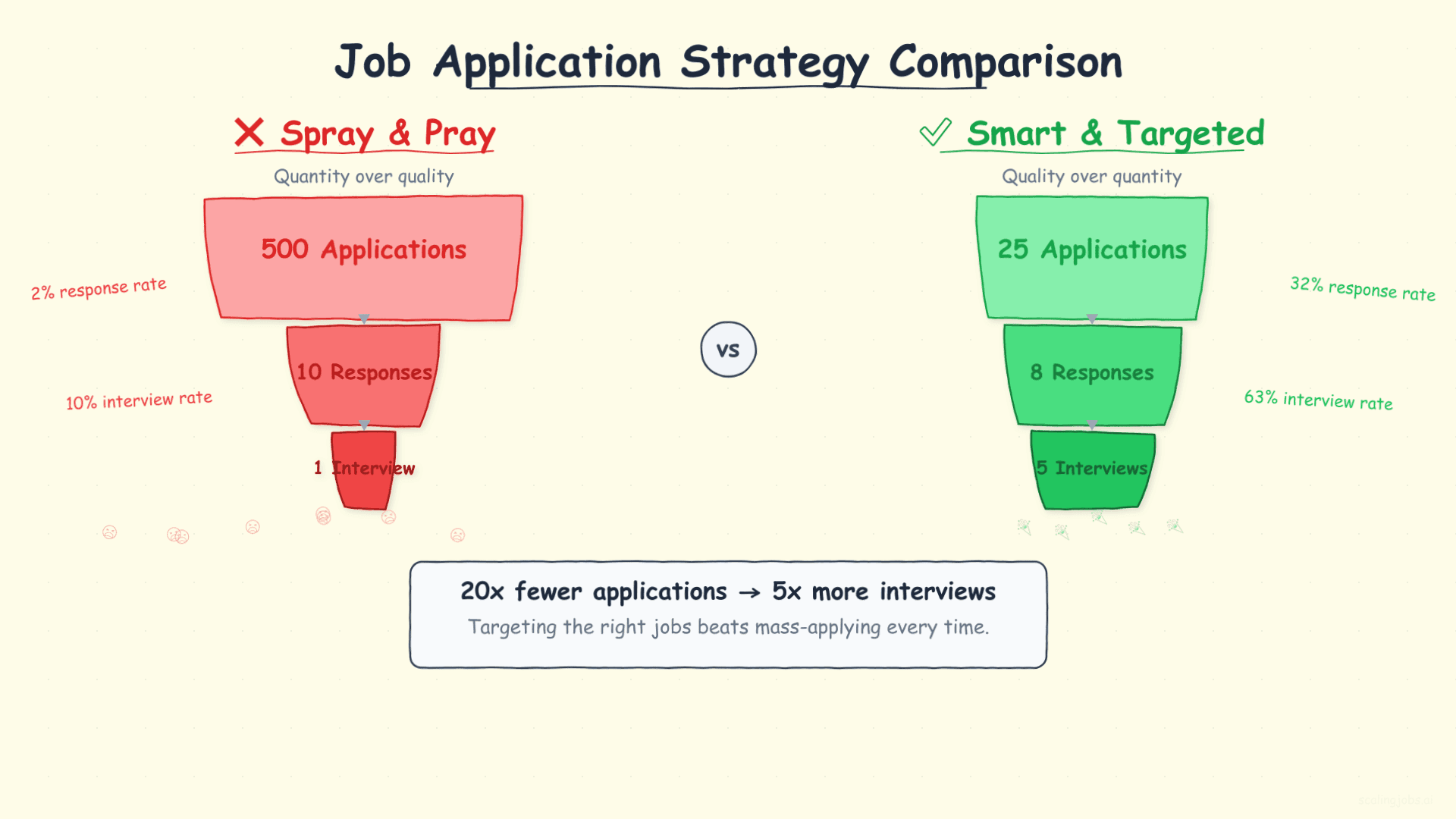
The numbers get more dramatic when you compare response rates directly. Mass-apply strategies yield a 1 to 3% response rate. Targeted, customized applications? 20 to 35%.
Think about it this way. You could spend 4 hours blasting out 50 generic resumes at 5 minutes each. Or you could spend 3.75 hours sending 5 tailored applications at 45 minutes each. The 5 tailored apps will generate more interviews than the 50 generic ones. Every single time.
Why does this happen? Recruiters spend an average of 6 seconds reviewing a resume. A generic application doesn't survive that 6-second scan. A tailored one, with the right keywords and relevant experience front and center, does.
The Hidden Cost Nobody Talks About: Your Mental Health
Here's what the "just apply to more" advice ignores completely: 46.8% of job seekers report negative mental health impacts from their search. Over half experience complete burnout from the application process alone.
One user on r/recruitinghell captured it perfectly: "Literally no one will hire me. It's really destroying my soul."
Mass-applying creates a vicious cycle. You send 50 applications. You get 48 rejections (or worse, 48 silences). Your confidence drops. Your next batch of applications gets sloppier because you're demoralized. The response rate falls even further. So you apply to more, hoping the numbers will save you. They won't.
The emotional weight of hundreds of silent rejections isn't a side effect. It's the primary cost. Your time, your energy, and your mental health are finite resources. Burning all three on a strategy that research says doesn't work isn't persistence. It's a trap.
The Smarter Application Strategy (5 Steps That Actually Work)
If volume isn't the answer, what is? A targeted approach that maximizes the impact of every application you send. Here's how to restructure your daily job search:
Step 1: Filter ruthlessly before you apply
Before you spend a single minute on a resume, ask: does this job actually match my skills? Is the listing real (not a ghost job)? Is the company actually hiring? Tools like AI job scoring can answer these questions in seconds. Without a filter, you're throwing darts blindfolded.
Step 2: Tailor your resume for each application
This is the single biggest lever. A resume customized for the specific role, with matching keywords and relevant experience highlighted, converts at 10 to 15x the rate of a generic one. Yes, it takes longer per application. That's the point. Or use AI resume tailoring to do it in 30 seconds instead of 45 minutes.
Step 3: Apply to 2 to 5 high-match jobs per day
Not 50. Not 20. Between 2 and 5, with each one carefully selected and each resume adjusted. If you're unemployed and have full days available, you might push to 5. If you're employed and searching on the side, 1 to 2 is plenty.
Step 4: Track everything
Which jobs did you apply to? Which version of your resume did you send? What was the response? Without tracking, you're flying blind. You can't improve what you don't measure. Use a spreadsheet, a tracker app, or a tool with built-in pipeline analytics.
Step 5: Redirect your time to high-impact activities
The hours you used to spend blasting out 50 generic applications? Put them into LinkedIn outreach, informational interviews, industry events, and direct messages to hiring managers. These channels have dramatically higher conversion rates than cold applications. And they compound over time in a way that mass-applying never does.

Stop Guessing. Start Scoring.
The answer to "how many jobs should I apply to per day" is simpler than you think: 2 to 5, each one chosen carefully and tailored specifically. The research is clear. Applicants who send 21 to 80 targeted applications outperform those who send 500 generic ones.
But doing this manually is brutal. Reading every job description, comparing it to your resume, rewriting bullet points, checking for ghost postings. It takes 45 minutes per application. Five a day means nearly 4 hours of grinding, repetitive work.
That's exactly what Scaling Jobs AI automates. It scores every job across 12 dimensions so you know which ones are worth your time. It flags ghost postings before you waste an application. And it tailors your resume for each role in about 30 seconds, so those 5 daily applications take minutes instead of hours.
Fewer applications. Better targeting. More interviews. That's not a theory. That's what the data shows.
Frequently Asked Questions
Is it okay to apply to 100 jobs a day?
Technically you can, but the data says it hurts more than it helps. Job seekers who apply to 81 or more positions have a 20.36% success rate, compared to 30.89% for those who apply to 21 to 80. At 100 per day, you're not customizing anything, which means you're competing with a 1 to 3% response rate instead of 20 to 35%.
How long should you spend on each job application?
For a properly tailored application, plan for 30 to 45 minutes. That includes reading the full job description, customizing your resume to match the role's keywords and requirements, and writing a targeted cover letter if required. AI resume tailoring tools can cut this to under 5 minutes per application while maintaining the same personalization quality.
What's the average response rate for job applications?
It varies dramatically by method. Generic online applications see a 1 to 3% response rate. Personalized, targeted applications see 20 to 35%. Referrals convert at the highest rate of all, often 50% or higher. The platform matters too: Google Jobs has a 9.3% response rate, while LinkedIn sits around 3.3%.