Why Is My Resume Getting Rejected by AI? (The Real Answer)
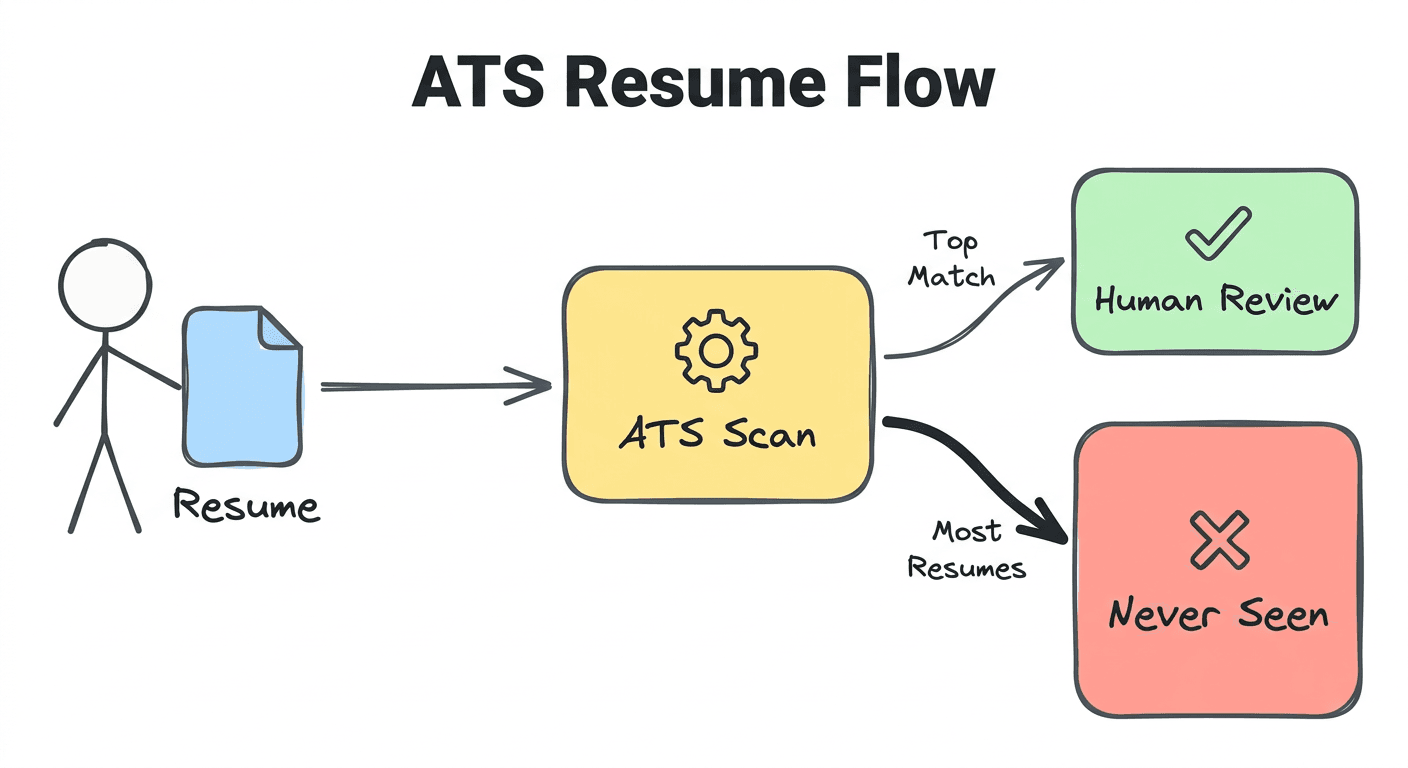
You've probably seen the stat: "75% of resumes are rejected by AI before a human ever sees them." It's everywhere. Career coaches quote it. LinkedIn posts repeat it. Resume services use it to sell you $300 rewrites.
There's one problem. That number came from a company called Preptel in 2012. Preptel was a recruiting services startup that used the stat in a sales pitch. They went out of business in 2013. No methodology was ever published. No study was ever conducted.
So why is your resume getting rejected by AI? The real answer is more nuanced, more fixable, and in some ways worse than a single scary percentage. Let's break it down.
The 75% Resume Rejection Myth (and What's Actually Happening)
In 2025, Enhancv interviewed 25 U.S. recruiters across 10+ ATS platforms. The finding? 92% confirmed their ATS does NOT auto-reject resumes based on formatting, design, or content. Only 2 out of 25 had configured any content-based auto-rejection, and even then, only for strict criteria like "match less than 75% of required skills."
That sounds like great news. It's not.
The average job posting receives 242 applications. Recruiters spend 7.4 seconds on an initial scan. Your resume isn't being "rejected by a robot." It's being ranked by one, buried under 241 other applicants, and never scrolled to by a human who ran out of time after reviewing the top 15.
So the system isn't auto-rejecting you. It's ranking you so low that you're invisible. The result is the same: you never hear back.
5 Reasons Your Resume Gets Rejected by AI (for Real)
EDLIGO analyzed 1,000 rejected resumes across Workday, Taleo, and Greenhouse. Their finding: 43% of rejections were caused by formatting, parsing, or filter failures, not qualification gaps. That means nearly half the people getting filtered out could have been qualified.
Here's what's actually tripping you up.
1. Your Resume Can't Be Parsed (23% of Rejections)
ATS reads your document top to bottom, left to right. Tables, multi-column layouts, text boxes, graphics, and infographics confuse the parser. It merges columns, skips text boxes entirely, and garbles anything inside a table cell. Content placed in headers or footers? Most ATS platforms can't read those at all. Your name and phone number disappear.
2. Keyword Mismatch
Most ATS platforms still rely on exact string matching. "Project management" and "managed projects" aren't the same thing to the algorithm. If the job description says "stakeholder engagement" and your resume says "client relations," you lose points. Same skill, different words, zero credit.
3. Wrong File Format
The EDLIGO analysis found a 4% failure rate for plain DOCX files versus an 18% failure rate for PDFs. That's a 4.5x difference just from file format. PDFs look beautiful to humans. Machines often can't parse them correctly, especially if they were exported from design tools like Canva or InDesign.
4. Skills Overload
Resumes listing 20+ skills in a standalone section had a 67% rejection rate. Resumes that integrated those same skills into experience descriptions? Just 34%. ATS gives more weight to skills that appear in context ("Led a team of 8 using Agile methodology") than skills dumped in a list ("Agile, Scrum, Leadership, Teamwork").
5. Employment Gap Filters
Nearly 50% of U.S. employers use a continuity-of-employment filter that automatically deprioritizes candidates with gaps longer than 6 months. Took time off to care for a family member, go back to school, or recover from burnout? The algorithm doesn't care why.

How ATS Actually Scores Your Resume
Understanding the scoring helps you beat it. 97.8% of Fortune 500 companies use an ATS. So do 60% of small businesses with fewer than 50 employees. You're almost certainly applying through one.
Modern ATS platforms use three methods to evaluate you:
- Exact string matching. Does the text in your resume contain the exact phrases from the job description? "Python" matches "Python." "Data analysis" matches "data analysis." But "analyzed data sets" might not match "data analysis."
- Semantic matching (advanced systems only). Some newer platforms use NLP to recognize that "team leadership" and "people management" mean similar things. Workday and Greenhouse are moving in this direction. Most older systems don't do this.
- Weighted scoring. Your resume gets a numerical score (typically 0 to 100%) based on keyword density, job title alignment, years of experience, education, certifications, and location match. The recruiter sees candidates sorted by this score.
Before scoring even starts, most systems run knockout filters: binary pass/fail questions about work authorization, required certifications, or minimum education level. If you fail a knockout, your score doesn't matter. You're out before the algorithm even reads your experience section.
How to Fix Your Resume for ATS

Every fix here is free and takes less than 10 minutes. Start with the highest-impact changes first.
Use a Single-Column, Plain DOCX Layout
Kill the two-column design. Remove text boxes, tables, graphics, and icons. Use standard section headers: "Experience," "Education," "Skills." Save as .docx, not PDF. This alone eliminates the 23% parsing failure category entirely.
Mirror the Job Description's Exact Language
Read the job posting carefully. If it says "cross-functional collaboration," don't write "worked with other teams." Use their words. Copy the exact phrasing for hard skills, software names, and certifications. ATS is a matching engine. Give it matches.
Integrate Skills Into Experience Bullets
Instead of a standalone "Skills" section listing 25 technologies, weave them into your job descriptions. "Built REST APIs in Python using FastAPI, reducing response times by 40%" beats a bullet point that just says "Python, FastAPI, REST APIs."
Remove Headers, Footers, and Fancy Formatting
Put your name and contact info in the main document body, not the header. Skip the photo, the logo, the colored sidebar. Every decorative element is a parsing risk with zero upside for the algorithm.
The Problem: This Takes 45 Minutes Per Application
You know the math already. If it takes 42 applications to land one interview, and each tailored resume takes 45 minutes, that's 31.5 hours of resume work for a single interview. Working full-time on applications, that's nearly an entire week of doing nothing but rewriting the same document over and over.
There are two ways to solve this. You can batch the process, create 3 to 4 resume templates for different job types, and swap keywords manually for each listing. Or you can automate it.
Stop Rewriting Your Resume 42 Times
Here's the core problem: ATS scores reward resumes that mirror the job description's exact language. Every job description is different. So every resume needs to be different. Doing that manually doesn't scale.
Scaling Jobs AI's resume tailoring does the rewrite for you. It runs a per-job gap analysis against each job description, rewrites your vocabulary to match the posting's terminology, reorders sections to highlight your most relevant experience, and exports an ATS-optimized DOCX in seconds.
It comes with a truthfulness guarantee: no skills are fabricated, no experience is invented, no certifications are added that you don't have. Every change is logged so you can review exactly what was modified.
You've already spent enough time reformatting the same document. Your next 42 applications don't have to take 31 hours.
Frequently Asked Questions About ATS Resume Rejection
What percentage of resumes are rejected by ATS?
The widely cited "75% rejected by ATS" stat has no research behind it. A 2025 Enhancv study found 92% of recruiters say their ATS does NOT auto-reject resumes. The real issue is ranking: with 242 applications per job opening, low-scoring resumes are never scrolled to by human reviewers.
Should I use PDF or DOCX for ATS?
DOCX. An EDLIGO analysis of 1,000 rejected resumes found a 4% failure rate for plain DOCX versus 18% for PDFs. PDFs created in design tools (Canva, InDesign, Figma) are especially problematic because the ATS can't parse the text layer correctly.
How do I know if my resume passed the ATS?
Most ATS platforms don't notify you about your score. The best proxy: if you hear back within 1 to 2 weeks of applying, your resume likely ranked well. If you consistently hear nothing after dozens of applications, it's a formatting or keyword mismatch issue. Paste the job description and your resume side by side and check for missing terms.